
Two paths, one passion: WSSU twins chart their own course in scientific research
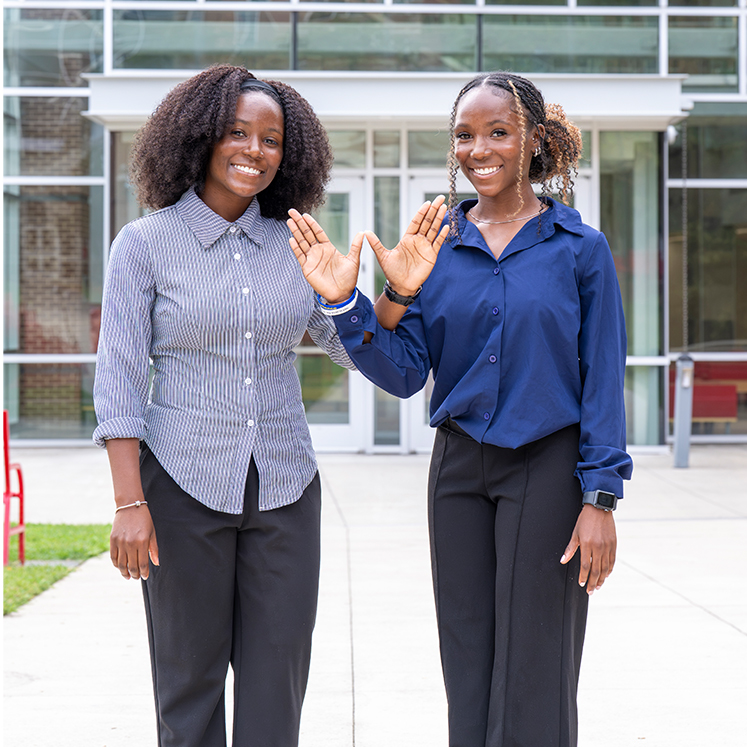
For eight weeks this summer, WSSU twins Cayla and Carlin Parrott pursued their academic goals nearly 2,240 miles apart.
Cayla conducted biomedical research at the University of California, Irvine. Her twin sister, Carlin, spent the summer researching soil bacteria at Wake Forest University – about 10 miles from the WSSU campus they share.
The sisters, who are from Columbia, South Carolina, are following different paths toward careers in health care. Cayla, who will graduate in spring 2027, hopes to become a researcher. Carlin, who is graduating a semester early in December, plans to become a physician assistant.
Their summer experiences were different, but both returned to WSSU with greater confidence in their abilities and with further confirmation they’re on paths they want to pursue.
They were featured in a video illustrating student success that premiered Sept. 11 during WSSU Chancellor Bonita J. Brown’s State of the Campus address. The video also included Dr. Manju Bhat, dean of the College of Arts, Sciences, and Education, and Dr. Sarah Adjei-Fremah, assistant professor of biological sciences.
Cayla and Carlin were highlighted for good reason.
From June 22 to Aug. 14, Cayla conducted research in the UC Irvine School of Medicine’s Translational Research in Vision Summer (TRAVIS) program, which featured students from Winston-Salem State University and North Carolina Agricultural and Technical State University. The students investigated gene editing and therapeutic approaches, inherited eye disorders, retinal disease models and neuroprotection.
Cayla researched a condition called amblyopia, commonly referred to as lazy eye, and also worked on projects involving glaucoma and whole eye transplant.
“I worked to develop an effective methodology for a behavior test called the Pole Descent Cliff Task,” Cayla explained. “I was tasked to develop an animal training approach that allows the lab to evaluate patterns associated with amblyopia in a rodent model so we can effectively treat this condition using electric field stimulation and observe how the treatment improves binocular vision. My findings showed progress that the methodology for training the rodent model was successful.”
Cayla’s efforts didn’t go unnoticed.
Anahit Simonyan, a UC Irvine neuromedicine Ph.D. candidate, described Cayla as hardworking, saying she spent time in the lab on Saturdays, and was curious and passionate about science.
“Cayla methodically trained the animals to go down a long pole that they otherwise found very scary,” Simonyan said. “Prior to Cayla, I was almost giving up on this experiment because I wasn’t as patient … but Cayla put together a four-day training protocol with various steps that allows us to prime the animals for the day of testing. So, not only did she develop a prepping protocol, but she was also able to show a difference between diseased and normal animals as well.”
Cayla said the UC Irvine experience confirmed her career choice.
“After I ran the behavior test, I was also able to assist other graduate students with their projects, such as glaucoma, pupillary response and whole eye transplant,” Cayla said.
“Not only was I doing lab work throughout the summer, but I was also working closely with graduate-level students and even got a couple of chances to present in lab meetings and at our final presentation symposium,” she continued. “My experiences gave me the confidence to feel like I can contribute in those spaces, and made my goals seem more attainable.”
Cayla learned about TRAVIS from Adjei-Fremah. Carlin learned about the Wake Forest opportunity from Dr. Akamu Jude Ewunkem, assistant professor of molecular and cellular biology at WSSU.
As part of the Wake Forest University National Science Foundation Research Fellowship, which ran from June 1-Aug. 7, Carlin studied Azotobacter vinelandii, a soil bacterium, to determine its ability to convert atmospheric nitrogen into a usable form.
“The reason for us doing this was to find a more natural way to fix nitrogen because most nitrogen is fixed industrially, which creates greenhouse gases, which harm the earth,” Carlin explained. “This was my first time working with this kind of bacteria.”
Carlin and her cohort resided on Wake Forest University’s campus for just under 10 weeks during the summer.
“It was nice being able to have a change of scenery,” she said. “Even though WSSU and WFU are in the same city, it was interesting seeing how things are done at Wake Forest and nice being able to interact with other people. There were students there from different institutions and different states, including one student from Massachusetts.
“The lab I was working in was almost like a combination of three classes that I’d taken the semester before – tissue culture, biomolecules and microbiology,” Carlin said. “So, it gave me a lot of prerequisite knowledge that helped me catch on in the lab.”
Dr. Patricia Dos Santos, an endowed Wake Forest University professor who leads a research group that includes undergraduate and Ph.D. students, runs the research lab in which Carlin worked.
“For some of the students, research is not really an integral part of their college education, so enabling those experiences at a research lab like Wake Forest expands the scope of their experiences during their college years,” Dos Santos said.
Wake Forest sponsored 10 fellows during the summer, including Carlin and three other WSSU students. Carlin was the only fellow assigned to Dos Santos’ lab. She described Carlin as responsible and professional and said she took the opportunity seriously.
“Definitely, there was a noticeable growth in her confidence level throughout the summer,” Dos Santos said. “Once she presented at the research symposium, she did a really nice job. I was very happy with her.”
Cayla and Carlin were miles apart during the summer but simultaneously impressed their supervisors. They said being separated was different but not as hard as others might expect.
“While we’re very close, we don’t have the clingy relationship a lot of twins have to where we’re inseparable,” Cayla said.
“Even though on campus we’re together, we work toward our own, independent goals,” Carlin added.
They credit their parents, Carl and Camesha Parrott, for instilling in them a strong work ethic and for constantly telling them they can do anything they aspire to do if they keep God first and work hard. They have a younger brother, Carl, a senior at Ridge View High School in Columbia, where they were both in the National Honor Society. Carlin was in the top 10% of their 2023 graduating class.
“Cayla and Carlin are highly motivated students who love science, are driven by their goal to succeed and take advantage of the opportunities they’re presented,” Bhat said. “They have the love and support of their family and their mentors at WSSU. They are humble and grounded and will be successful in whatever they choose to pursue.”